Pages

Thursday, August 12, 2010

Long Live The Greeks ... But Will They Prosper?

Today's guest blogger is Archelle Georgiou, MD.  Her blog, "Archelle on Health" is a fabulous resource for all things health-related.  In this post, she shares with us a recent trip to Greece with her family ... and the lessons she learned there.

Celebrity chef, Andrew Zimmern, said it well in a recent article, "Headlines be damned. Greece is still open for business."

Well, sort of. . .

My family and I recently returned from a month long trip to Greece. Indeed, it was glorious, and it would be fun to write about the exquisite meals, the inspiring history, and the experience of "moving in" to Lahania, the small village (population: 50) where my father was born. But, that's not what I'm writing about because, frankly, I expected that we would have a wonderful vacation. What I wasn't expecting is that I would get an insider's view of the Greek economic crisis.

It started the moment we arrived. The plan for our first full day in Athens was to visit the New Acropolis Museum that opened to rave reviews in 2009. It cost $200 million and sits near the base of the Acropolis with a direct view of the Parthenon. BUT....we were promptly informed that the museum was closed. In fact, all of the historical sites were closed due to a 1-day national strike.

Two and half million public and private sector workers in Greece were on strike in Athens and other major cities protesting the European Union-International Monetary Fund austerity measures. This particular strike was scheduled on the same day that the Parliament was voting on a bill to increase the retirement age to 65 and decrease early pensions for workers. FYI...the Greek government has policies that promise early retirement (age 50 for women and 55 for men) to 700,000 people. Warning: Don't get in between a Greek and their "syntaxi" -- their retirement check.

No problem...we decided to spend the day in Varkiza, one of the lovely beaches just outside of the city.

Interestingly, despite the palpable anger and frustration (with their own government, not the EU or IMF), we didn't see any picket lines or strikers. The beach, however, was packed with locals who were thrilled to have a day off. Little did we know that this was the 5th national strike since February with the sixth strike scheduled for July 25.

Over the course of the next four weeks, we had many conversations about the financial crisis, and there were two consistent themes regarding the root cause: overspending and fraud.

Overspending

There are many reports that suggest that the 2004 Olympic Games put the country into a downward spiral, and this issue came up frequently in our discussions. Costing $11 billion dollars, in addition to infrastructure costs, this was 50% over budget and clearly more than the country could afford. In our conversations, however, the prevailing perspective was that it was the government's fault.

Maybe so, but there is a long history of overspending, in the form of entitlements, that the country cannot afford to continue but, yet, the people don't want to give up. Did you know:
  • As a way to stimulate population growth, women who have three or more more children are given a lifetime stipend. One family that we were with has four sons. All are adults, and the mother continues to receives 200 euros per month...forever.
  • As a way to stimulate tourism, the government established incentives for entrepreneurs to build hotels and open restaurants. And, what a deal! The government gifted--yes, paid for...60% of the development costs for new projects. This helps explains why the islands are lined with large, luxurious hotels with a 57% average hotel occupancy rate.
  • All employees receive two bonuses a year: a Christmas bonus equal to one month of salary and an Easter bonus equal to two weeks of salary. So, employers are obligated to pay 13.5 months of wages for 12 months of work. Can anyone say pay for performance? Management discretion? Nah.
Fraud

The common enemy among those we spoke to is the 2004-2009 government led by Kostas Karamanlis. "They stole our money! Why should we suffer as a result of those criminals?"

Agree. Many articles describe Karamanlis' reign as corrupt and scandalous with fraudulent financial practices. But, fraud is not limited to the government. Greece has a well-known, long history of tax evasion that costs the country $20.5 billion per year.

While I was well aware of the tax evasion, I didn't realize how much fraud is woven into the country's culture. Defrauding "the system" is not considered unethical, it's how they win. They don't hide it. Rather they brag about it -- because it's the norm. We heard several examples that simply made us cringe:

  • In casual conversation, one gentleman was telling us about his fifteen day hospital stay; the doctor submitted a bill for thirty. One of long time friends, a US citizen, didn't have insurance in Greece but needed Lovenox, an expensive medication to prevent blood clots. She had a doctor write the prescription for her mother, a Greek citizen, who was insured by the national plan. An economist and health care broker estimated that 10% of health care costs are fraudulent.
  • Business going under? Set it on fire and start over. Arson drives about 20% of fire insurance claims.
  • It was recently discovered that on top of the 2.6 million people getting a retirement check, there are an additional 160,000 people are on the pension rolls. Here's the problem: they are dead and their families are still cashing the checks.
As a Greek, I deeply disappointed. As a US citizen, I am deeply concerned because it seems that the EU-IMF's rescue loan will only have a sustainable impact if the country's values are re-wired to include personal accountability and integrity. However, in my opinion, the prognosis is dim and, according to Alberto Alesina, a professor of political economy at Harvard, "...what matters is (the) family....there is less of a sense of duty towards the state." (WSJ, 2/10/1010). In other words, less money in the government's pocket means more money in the family's pocket. And, that's what matters most.

The Greeks' unflappable commitment to their families is both their greatest strength and their greatest weakness. Extended families frequently live within steps of each other and eat two meals together...every day. Young adults enjoy spending time with their parents and live at home until they are married. The elderly are included as an important member of the family, and placement of seniors in nursing homes is the exception rather than the rule. It is well known that family connectivity, meaningful conversation, and interacting with people who make us feel loved and appreciated is a key component of longevity. The life expectancy in Greece is 79.8 years versus 78.2 years in the US.

So, what's the bottom line? Take a trip to Greece. Eat a Mediterranean diet. Get up and dance on the tables. Drink ouzo. Take a nap. Watch very carefully how families interact.

Then, come home to the good 'ol USA and incorporate the good that you've learned into your life.

Create Health,
Archelle

For more information, visit Army Well-Being: Health Information.

Monday, August 09, 2010

An Open Letter to Teachers of Military Kids

Today's guest blog post comes from This Fabulous Army Life and reminds us that back-to-school can mean different things to different students ... and our military kids may have more on their minds than just first day of school jitters.

My military kids heading back to school
Dear Professional Educators,

For most kids, Back to School means school supplies, new shoes, and a reluctant farewell to the lazy days of summer. For military kids, it might be a bit more complicated. If you have military kids in your classroom, this letter is just for you!

On the first day of school, many of our military kids will be attending yet another new school. They will have to learn new rules and procedures, introduce themselves to new friends, and try to find their place in a world that is brand-new to them.

Remember that they may have just moved into the area, leaving behind close friends and familiar surroundings. It could be that they are still living out of boxes since their family’s household goods were delivered the day before. Or they might be the ones who stayed in their home while their closest friends moved on to a new installation in another state. Thank you for providing them a comfortable, safe place at school to learn and grow.

If these military kids have a parent deployed, they are in a special group all to themselves. This group of children may need additional support, extra attention, and a touch of compassion for their unique situation. When a young mind is worried about the safety of their parent, it changes their perspective on life and could affect their school performance.

If one appears uninterested in geography, it may be that he is distracted, thinking about countries like Afghanistan and Iraq, where his hero has been and is currently deployed. If another becomes aggressive at recess, consider that she may be acting out on emotions she doesn’t even understand. They miss their Soldier-parents. Thank you for showing them kindness and helping them learn appropriate ways to handle their frustration.

Finally, thank you for taking on the challenge of educating today’s youth. We appreciate your dedication to teaching and encouraging our children. Along with their peers, they need teachers like you, who will care about them, set high standards, and work to ensure their success. We look forward to working with you to determine the best learning possible for our kids and making this a successful school year.

Very Sincerely,
Military Parents

Leave a comment or share your tips for preparing our military kids for a new school year!

Wednesday, July 21, 2010

"Our Normal" Between Deployments

Guest blogger Christina Piper describes how deployment affects daily life for military Families, even during the coveted "dwell time" when servicemembers are at home with their Families.  It's a powerful post with which many Army Families can identify and empathize.  Read more of Christina's posts at "Her War, Her Voice" blog.

I am thinking that we might be hitting our normal, at least normal for us. We still have crazy hours, and the Army is still a very active role in our lives but deployment shenanigans have almost disappeared.

It has almost been a year and a half since his last return from war. The dreams have stopped. I am not jumping at fireworks, and his jumps are not as noticeable. I am use to sleeping next to him again, and will rarely double check if he is really there. I am not shocked to hear his voice in the mornings, or as annoyed when my stuff is moved around in the bathroom. There is now space for him. There is now space for Us.

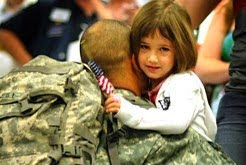
The kids are coming around. My girl lives for every moment spent in his arms. She watches for any opening to touch him, and love him. She is no longer crying for him at night, and looks forward to doing anything that he is a part of. Her laugh fills the air when he is around.

My son is still giving him a hard time, but there are moments that his walls come down. There are moments when he will cuddle up in his lap and chill. He can’t wait for wrestle time, playful arguments, and any sort of competition. He struggles with showing his love, but it is there.

I see my husband relaxing into this life, again, and there is a sense of peace in him, at times. I also see him react to the news that his guys are going again, and I know that he would go with them, given the choice. I don’t feel him flinch when I touch him, and his smile is reaching his eyes, at last.

I am beginning to let my guard down, and that scares me. I am enjoying normal in this moment, and I am waiting for the next set of orders. Deployment gnaws at the back of my mind like a rat trying to get into a seed bag, persistent and relentless. Guilt swims in my veins at every word from others facing the “D” word. I cry, and I know that that will be us again.

I fear the fourth long deployment. I fear it, and I know that it is coming. It is coming like the tide, and I don’t know when it will arrive. But I feel it lingering there waiting to break up our normal. Waiting to tear at us, and challenge us again. Waiting to put tears in my children’s eyes, and waiting to take him away. Waiting to take him away from us, yet again.

We will live in normal while we can, for as long as we can. I will breathe his smell in deep, for I know what it is like when that smell is absent for a year or more. I will be thankful for this time, and cherish it while I can. I will hold him in spades, wash his underwear, and deal with his foul habits, because when he is called again to war I will need to look back on normal.

More Resources for Deployment Cycle Support

Friday, July 16, 2010

Soldiers are Encouraged to Reach Out, Talk, and Listen

This blog post appears in the DoD Live Blog.

Army Suicide Prevention

The Army’s commitment to providing all members of the Army Family with the support and care they deserve is unwavering. Army leaders are speaking out to let Soldiers, DA Civilians, and Family members know that their mental health is just as important as their physical health, and that when they need help staying mentally fit, there is always someone within their Army Family ready and willing to help.

Army leaders aren’t the only ones speaking out. Those who’ve experienced emotional crises, sought help to heal their wounds, and have emerged stronger Soldiers as a result, are coming forward to let others who are struggling know that they are not alone.

Shoulder to Shoulder: I Will Never Quit on Life features vignettes and testimonials of real Soldiers, DA Civilians, and Family members who received help for psychological distress or who assisted an individual in need.

Designed to be used as a supplemental resource for the Army-approved suicide prevention and awareness training model, ACE (Ask, Care, Escort), the video illustrates how we can work together to keep each other, and our Army, mentally fit.

Suicide is not just a problem within the Army. The stories and underlying messages apply to all of us. Soldiers, Army Civilians, Family members and the public are all encouraged to watch Shoulder to Shoulder, and consider how they can live by the examples of these Army Strong Family members.


Have you or someone you know experienced similar struggles? How did you cope?

For Immediate Concerns

The Army Suicide Prevention Office is not a crisis center and does not provide counseling services. If you are feeling distressed or hopeless, thinking about death or wanting to die, or, if you are concerned about someone who may be suicidal, please contact Suicide Prevention Lifeline at 1-800-273-TALK (8255).

For more information, visit www.preventsuicide.army.mil.

Back to Suicide Prevention

Saturday, July 03, 2010

Remembering Our Heroes as we Celebrate Our Freedom

The 4th of July is a favorite holiday of many in the United States. And why not? Celebrating the freedoms we enjoy daily is a great thing to do. From fireworks and family gatherings to cook-outs and picnics, Independence Day is a true celebration.

At Army Well-Being, we wanted to bring you some must-see stories about our heroes who are fighting for those very freedoms, even now. Take a moment to remember those who have sacrificed so much for the values we hold so dear.

Some great reading for you on this holiday:

Independence Day Greetings from Combat

On Independence Day, like many other holidays, Soldiers are given the opportunity to send a shout-out to their loved ones back home.  This is a great service provided by Army broadcasters, but not too many people know where to look for these videos. The Digital Video & Imagery Distribution System holds on to thousands of these greetings, so visit DVIDS Greetings and see if you can find your Soldier this Independence Day.


Remember the Price Paid for Independence Day Celebrations


For most of us, the 4th of July will be filled with family gatherings, festivals, and fireworks. While we enjoy our freedoms here in the states, U.S. military members around the world are patrolling deserts, flying in darkness, navigating the high seas and risking their lives in far-off places. This commentary is an attempt to put that aspect of America's independence into perspective and offer an expression of gratitude for all that American warfighters have done and continue to do.


Thinking About Independence Day


This blog post, from the Jane Wayne blog, is written by an Army spouse and reminds us to think of all our servicemembers on this Independence Day.  As we approach our Nation’s birthday, I am always reminded of the service and sacrifice of so many who have come before us. From the day that we adopted the Declaration of Independence in 1776 until today, brave men and women have served, sacrificed, fought, and died to preserve it. Freedom truly is not free.


Happy Independence Day from all of us at Army Well-Being!